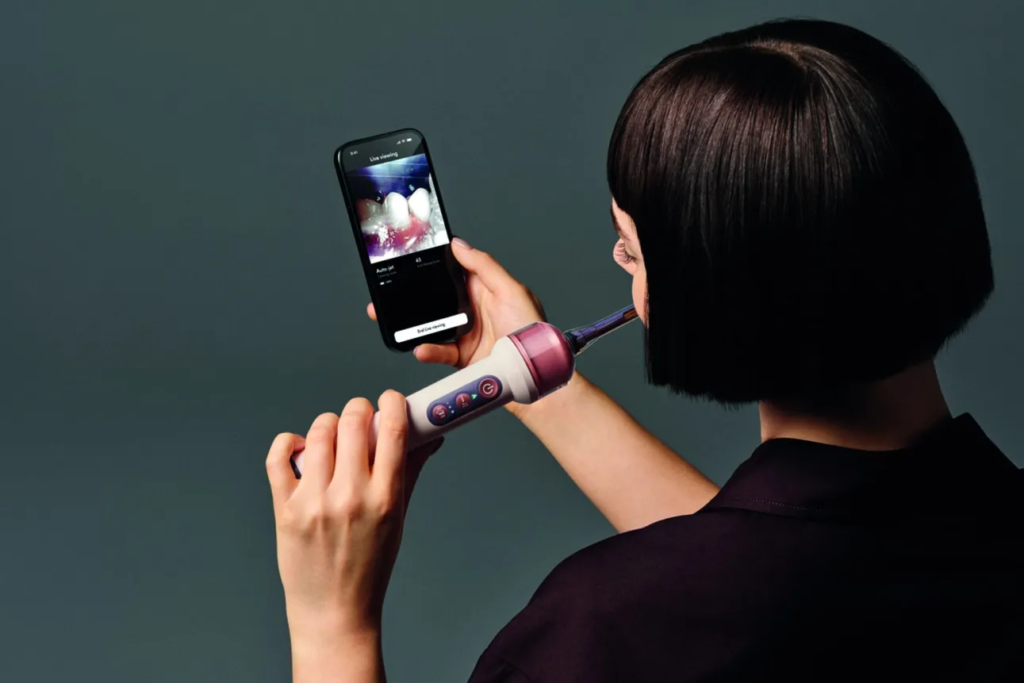
Dyson’s new CameraJet combines artificial intelligence, an integrated camera and a precision water jet to clean between your teeth. But can an AI toothbrush really replace traditional flossing?
The toothbrush has changed considerably over the past few decades. Electric motors, pressure sensors, timers and smartphone apps have transformed the way many people approach their daily oral hygiene. Now, Dyson is taking things a step further.
Launched in September 2026, the Dyson CameraJet combines an electric toothbrush with a built-in camera, machine-learning technology and a targeted liquid jet designed to clean between the teeth while you brush. Dyson describes it as a toothbrush that can “see” interdental gaps, identify them in real time and deliver a targeted burst of mouthrinse.
But impressive technology doesn’t necessarily mean better dental health. At Carling Dental, we take a closer look at the technology, the research behind it and what it could mean for your everyday oral-health routine.
What Is the Dyson CameraJet?
The Dyson CameraJet is a premium electric toothbrush designed to combine brushing and targeted interdental cleaning in a single device. Unlike a conventional electric toothbrush, the CameraJet contains an integrated 100,000-pixel macro camera and Dyson’s machine-learning technology, known as Gap Optical Targeting™.
According to Dyson, the camera captures 28 images per second to identify, track and predict the spaces between teeth. When the system detects an interdental gap, it can trigger a precision jet of mouthrinse towards that area.
Dyson says the technology is the result of six years of research and development and that its machine-learning system was trained using 470,000 dental images collected during development.
The result is essentially several oral-care technologies combined into one device:
- Electric toothbrush
- Targeted water-jet cleaning
- Built-in intraoral-style camera
- AI-powered gap detection
- Brushing feedback
- Smartphone connectivity
- Mouthrinse delivery
It is a very different approach to conventional brushing.
Dyson’s official CameraJet research and product information
Can the Dyson CameraJet Replace Flossing?
The short answer: not necessarily.
It would be misleading to say that the CameraJet has definitively made traditional flossing obsolete. Instead, it is better to view the CameraJet as a new approach to interdental cleaning. Traditional dental floss physically passes between the teeth and is used to clean the surfaces around the contact point and gumline. Water flossers use a stream of liquid to help disrupt and remove plaque and debris around interdental areas. The CameraJet combines targeted liquid cleaning with brushing and attempts to automate the targeting process.
However, there is an important limitation: The CameraJet is a newly launched product, so long-term independent evidence about its clinical performance is naturally much more limited.
What Does Dyson’s Clinical Research Show?
Dyson reports clinical testing of the CameraJet. According to Dyson, a six-week clinical study involving 204 participants compared brushing twice daily in Brush and Auto-Jet mode with a manual toothbrush. Dyson reports improvements in gum-health measures from this study.
Dyson also reports other testing involving plaque removal and its various brushing modes. However, the comparison is important. The headline evidence does not demonstrate that the CameraJet is better than traditional flossing in every situation. Rather, Dyson’s reported clinical study compares the CameraJet’s Brush and Auto-Jet mode with a manual toothbrush. Other performance claims are based on laboratory testing. That means we should be careful about interpreting the results. The evidence is encouraging for the technology, but it would be premature to conclude that the CameraJet eliminates the need for all other forms of interdental cleaning.
Does a More Expensive Toothbrush Mean Better Oral Health?
Not necessarily.
The Dyson CameraJet sits firmly at the premium end of the toothbrush market. Technology can make an oral-care routine more engaging and may help some people improve their technique, but an expensive toothbrush is not automatically better for every person. The NHS’s advice remains relatively straightforward: brush regularly with fluoride toothpaste and clean between your teeth using an appropriate method.
In other words: You don’t need an AI toothbrush to have healthy teeth and gums. The most important thing is having an effective routine that you can maintain consistently.
Who Could Benefit From an AI Toothbrush Like the CameraJet?
The CameraJet may be particularly interesting for people who:
- Frequently miss areas while brushing
- Find conventional flossing difficult
- Prefer technology-assisted routines
- Want detailed feedback about brushing
- Struggle to clean consistently between their teeth
- Have an interest in smart health technology
- Want to combine brushing and targeted liquid cleaning
However, there is no universal oral-care routine that works identically for everyone. The most appropriate interdental-cleaning method depends on factors such as:
- The size of the spaces between your teeth
- Gum health
- Tooth alignment
- Dental restorations
- Orthodontic treatment
- Implants
- Bridges
- Individual dexterity and technique
Can the Dyson CameraJet Replace Your Dentist?
No.
This is one area where there is no technological shortcut. The CameraJet’s camera is designed to help users see their teeth and guide their cleaning routine. It does not replace a professional dental examination. A dentist can assess issues that a toothbrush cannot reliably diagnose, including:
- Tooth decay
- Gum disease
- Periodontal problems
- Tooth wear
- Cracks
- Restorations
- Bite issues
- Problems around implants
- Conditions requiring X-rays or further investigation
Technology can support prevention. It cannot replace personalised dental care.
So, Should You Buy the Dyson CameraJet?
There isn’t a simple yes-or-no answer.
If you enjoy technology and want a toothbrush that combines AI, a built in camera, sonic brushing, targeted liquid cleaning, app based feedback and coverage tracking, then the CameraJet is certainly an interesting development.
For someone who struggles with interdental cleaning or wants more feedback about their brushing, its technology may be particularly appealing.
But if your goal is simply to maintain healthy teeth and gums, you do not need a £400+ AI toothbrush. Good brushing technique, fluoride toothpaste, daily interdental cleaning and regular professional dental care remain the foundations of oral health. The best oral-care device is ultimately the one that helps you maintain an effective routine consistently.
What Does the Development of the Dyson CameraJet Mean for Oral Care?
The development of the Dyson CameraJet signals an interesting shift in the way we think about everyday oral care. For years, innovation in toothbrushes has largely focused on improving brushing performance from electric motors and pressure sensors to timers and smartphone connectivity. The CameraJet takes a different approach by attempting to identify the areas that brushing alone may miss.
The fact that an AI-powered toothbrush is now being designed to recognise the spaces between your teeth highlights just how important interdental cleaning is to maintaining good oral health. Cleaning Between Your Teeth May Be More Important Than Having an AI Toothbrush. In other words, the most interesting thing about the CameraJet may not be that there is now an AI toothbrush.
It is that one of the world’s biggest technology companies has identified cleaning between the teeth as an important enough problem to build an entire AI-powered system around it.
Traditional options such as floss and interdental brushes remain established ways of cleaning between teeth, while water-based devices offer another approach. The NHS recommends cleaning between the teeth regularly and advises speaking to a dental professional about the most appropriate method for your individual needs. NHS guidance on keeping your teeth clean. So, while the CameraJet may represent the future of smart oral-care technology, its development reinforces a much simpler message:
Before asking whether you need an AI toothbrush, ask whether you are effectively cleaning between your teeth.
The Carling Dental Verdict
The Dyson CameraJet is one of the most interesting developments in consumer oral-care technology in recent years. Its most significant innovation isn’t simply putting a camera into a toothbrush. It is the attempt to identify the areas people may miss and automatically target them during brushing.
That concept has genuine potential.
The research behind the technology is also interesting, particularly Dyson’s collaboration with NUS Dentistry and its clinical testing programme. However, the technology is still new. Current evidence does not justify saying that the CameraJet has made traditional flossing, interdental brushes or professional dental care unnecessary. Instead, it may be better viewed as another tool that could help people improve their oral-hygiene routine.
At Carling Dental, we believe technology works best alongside evidence-based, personalised dental care. Your toothbrush can help remove plaque. Your dentist can help you understand why plaque is accumulating, whether your gums are healthy and what your individual oral-care routine should look like.
If you are experiencing bleeding gums, persistent bad breath, sensitivity or difficulty cleaning between your teeth, speak to your dental team rather than simply upgrading your toothbrush.