Choosing how to straighten your teeth is no longer simply a choice between braces or no braces. Today, patients can choose from clear aligners such as Invisalign®, tooth-coloured ceramic braces, and traditional metal braces.
But which option is right for you?
The answer depends on several factors, including your orthodontic needs, lifestyle, aesthetic preferences, oral hygiene and the type of tooth movement required. Research suggests that both clear aligners and fixed braces can be effective, but their effectiveness can vary depending on the complexity of the case.
Invisalign® Clear Aligners
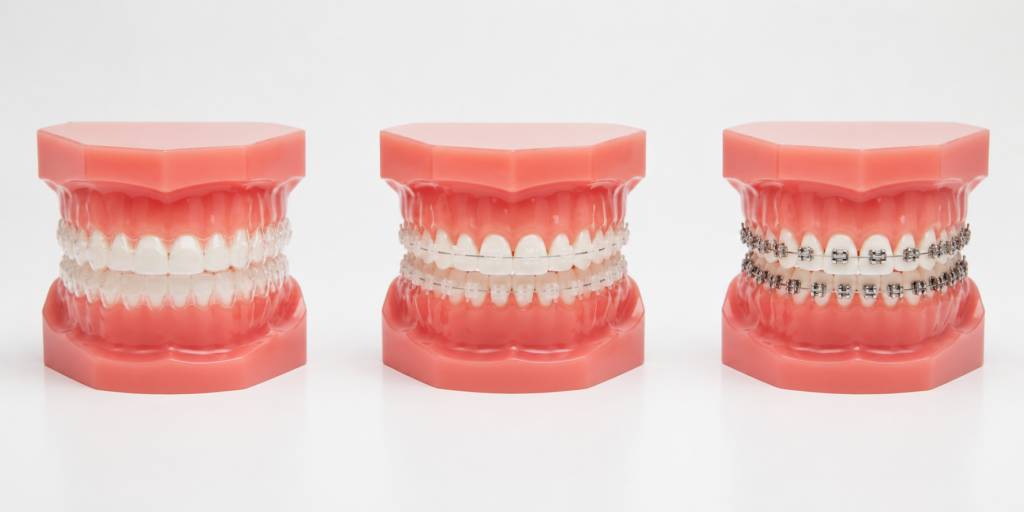
Invisalign® uses a series of custom-made, transparent aligners that gradually move your teeth. They can be removed when eating, drinking, brushing and flossing. One of their biggest advantages is their discreet appearance. They can also make daily oral hygiene easier because you can remove the aligners to brush and clean between your teeth.
However, clear aligners require commitment. They need to be worn for most of the day according to your treatment plan, and treatment can be affected if they are not worn consistently. Research suggests that clear aligners can be an effective alternative to fixed appliances for selected mild-to-moderate cases, although fixed appliances may provide better results for some complex tooth movements.
You can learn more about clear aligner treatment from the British Orthodontic Society.
Ceramic Braces
Ceramic braces work using the same basic principle as traditional fixed braces, but use clear or tooth-coloured brackets, making them less noticeable. They are fixed to your teeth throughout treatment, so you don’t need to remember to wear them. This can make them an appealing option for people who want the control of fixed braces but prefer a more discreet appearance.
As with other fixed braces, however, cleaning requires extra care around the brackets and wires. The British Orthodontic Society recognises ceramic or tooth-coloured brackets as one of the available types of fixed orthodontic appliances.
Read more about different orthodontic appliances from the British Orthodontic Society.
Traditional Metal Braces
Traditional metal braces remain one of the most established orthodontic treatments. They use brackets and archwires to apply controlled forces to gradually move teeth. Because they are fixed, they work continuously without relying on the patient remembering to put them in.
They are also capable of treating a wide range of orthodontic problems. The main disadvantages are their visibility and the additional care needed to clean around the brackets and wires. The NHS explains that braces are used to straighten teeth and can also help correct problems with the position of the teeth and bite.
Read the NHS guide to braces and orthodontic treatment.
| Invisalign® | Ceramic Braces | Metal Braces | |
| Appearance | Almost Invisible | Tooth-coloured | Most noticeable |
| Removable | Yes | No | No |
| Eating | Remove before eating | Some restrictions | Some restrictions |
| Cleaning | Generally easier | Requires extra care | Requires extra care |
| Caompliance | Requires consistent wear | Fixed | Fixed |
| Complex Cases | Depends on the case | Can treat many cases | Suitable for many complex cases |
| Main Advantage | Discreet and removable | Discreet and fixed | Versatile and established |
Which Treatment is Most Effective?
There isn’t one treatment that is best for everyone. Invisalign®, ceramic braces and traditional metal braces can all be effective, but the right choice depends on your teeth, bite and the type of movement needed.
For simpler alignment concerns, clear aligners can be a convenient and discreet option. For more complex tooth movements, fixed braces may sometimes give your dentist greater control. Your lifestyle also matters — particularly if you choose aligners, as they need to be worn consistently.
So, instead of asking “Which treatment is best?”, the better question is: “Which treatment is best for my teeth?”
During a consultation, your dentist or orthodontist can assess your teeth, discuss your goals and recommend the option that best suits your individual needs.
What about Comfort and Oral Hygiene?
Clear aligners are removable, which allows you to brush and clean between your teeth normally. Some research has found better short-term periodontal outcomes and less early treatment discomfort with clear aligners compared with fixed appliances. However, the certainty of evidence varies, so these findings should not be interpreted as meaning that aligners are always more comfortable or healthier.
With braces, careful cleaning around brackets and wires is particularly important. Regardless of the appliance you choose, good oral hygiene throughout orthodontic treatment is essential.
How Long Does Treatment Take?
There is no single treatment time that applies to everyone. Your treatment duration will depend on:
- The amount of tooth movement required
- Your bite and orthodontic problem
- The treatment method selected
- How consistently you follow your treatment plan
- Whether additional adjustments or refinements are needed
Rather than relying on an average number of months, your dentist or orthodontist should give you an estimated treatment time based on your individual assessment.
Do You Need Retainers Afterwards?
Yes.
Orthodontic treatment doesn’t end when your braces or aligners are removed. Teeth can naturally move over time, which is why retainers are an important part of orthodontic aftercare. The British Orthodontic Society explains that retention is an essential part of maintaining orthodontic results.
Find out more about orthodontic retention from the British Orthodontic Society.
Explore Your Orthodontic Options at Carling Dental
At Carling Dental, Harley Street, we believe orthodontic treatment should be tailored to the individual rather than based on a one-size-fits-all approach. If you’re considering Invisalign®, ceramic braces or traditional braces, our team can assess your teeth and discuss the options available to you.